
How to Pack Glasses and Cups for Moving (So Every One Arrives in One Piece)
To pack glasses for moving, wrap each one on its own in packing paper (or a clean sock or tea towel), stuff the inside, and stand it upright in a small, double-walled box with cell dividers. Heavy mugs and tumblers go on the bottom, wine glasses go on top, and every gap gets filled so nothing can shift. Then label the box FRAGILE on every side and keep it off the bottom of the stack.
Almost everyone packs their own glasses. Across Instamove bookings over the previous year, only about 1 in 100 added our pre-move packing service, so the kitchen cupboards were almost always packed by the person moving.
That's why we put this guide together. Here's how to do it properly, including the clever trick of using your own clothes as padding.
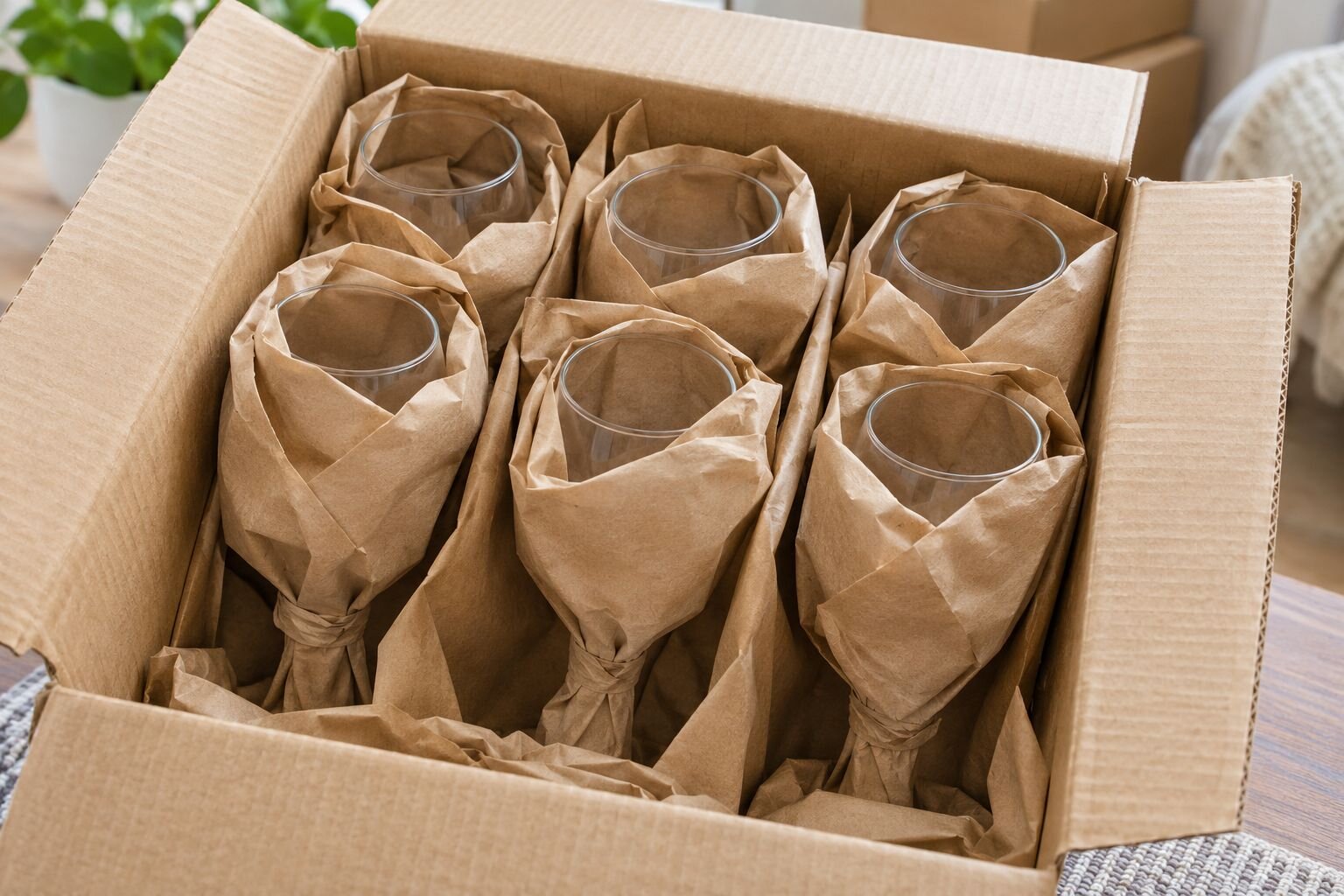
What you need to pack glasses and cups
You need small sturdy boxes, plenty of wrapping, something to fill gaps, and good tape. Most of it you can buy once from your removalist, and some of it is already in your wardrobe.
| Material | Best for | Watch out for |
|---|---|---|
| Plain packing paper (butcher's paper) | Wrapping every glass, stuffing cups, filling gaps | Buy more than you think. You'll use sheets fast. |
| Bubble wrap | Stemware, crystal and anything with a fine rim | Wrap paper first, bubble second, so the plastic doesn't mark |
| Clean socks, T-shirts and tea towels | Everyday tumblers, mugs, and filling gaps | Fine for sturdy glasses. Not enough on its own for crystal. |
| Cardboard cell dividers | Keeping glasses apart inside the box | Check the cells fit your tallest glass |
| Small double-walled boxes | Glasses, cups and mugs | Never use a big box for glassware |
| Packing tape and a marker | Reinforcing the base, labelling | Tape the bottom twice, in a cross |
Skip newspaper. The ink rubs off on glassware and you'll end up washing every glass twice.
If you'd rather have the lot delivered in one go, our packing materials page has boxes, paper, bubble wrap and tape sized for a household move.
Choosing the right box for glasses
Glasses always go in small boxes. A big box full of glassware gets heavy, gets dropped, and gets crushed under something else.
A box about the size of our book box (max 52 litres) is about as large as you want for glassware. Smaller is even better for crystal and stemware.
What makes a good glassware box:
- Double-walled cardboard. It holds its shape when other boxes sit on it.
- New, or close to it. Old supermarket boxes have often been damp or crushed.
- A taped base. Run tape along the centre seam, then across it, so the bottom can't give way.
- Cell dividers. They stop glasses touching, which is where most breakages start.
How to wrap everyday glasses, mugs and cups
Wrap every single glass on its own. It feels slow at first, but you'll find a rhythm by the third one.
For tumblers and everyday glasses:
- Lay a sheet of packing paper flat on the bench.
- Scrunch a small piece of paper and push it inside the glass.
- Lay the glass on its side at one corner and roll it up in the sheet.
- Tuck the ends into the opening at the top and bottom.
- Add a second sheet if the glass is thin.
Mugs and cups are tougher, but the handle is their weak point. Wrap a little paper around the handle first, stuff the inside, then wrap the whole mug.
Sturdy mugs can be nested two at a time if each one is wrapped and there's paper between them. Never nest glasses. They wedge together and crack when you try to pull them apart.
How to pack wine glasses and stemware
Wine glasses need the most care, because the stem and the rim are both thin. Treat each one like it's the last of your wedding set (it might be).
Here's the method for stemware:
- Fill the bowl. Gently stuff it with scrunched paper so the rim is supported from inside.
- Wrap the stem. Roll a strip of paper around the stem until it's as thick as the base.
- Wrap the whole glass. Use two sheets of paper, then a layer of bubble wrap for crystal.
- Stand it upright. Never lay a wine glass on its side in the box.
- Top layer only. Stemware always travels on top, with nothing heavy above it.
Champagne flutes and good crystal deserve their own small box. If you still have the original box they came in, use it.

Use your clothes and linen as padding
Your wardrobe is full of free, soft padding, and you're moving it anyway. Using clothes to protect glasses saves paper, saves boxes, and gives the clothes a job on the way.
The best clothing tricks for glassware:
- Socks over tumblers. Slide each everyday glass into a clean, thick sock before wrapping it in paper. It's a cushion and a dust cover in one.
- Tea towels around mugs. Roll a mug in a tea towel instead of paper. The kitchen linen has to go somewhere.
- T-shirts and jumpers as filler. Fold soft tops into the gaps between wrapped glasses, and use one as a cushion on the base and the top of the box.
- Beanies and scarves for odd shapes. Jugs and teapots fit nicely inside a knitted beanie.
A few rules so this works rather than backfires:
- Only use clean clothes. Nobody wants to unpack a wine glass from a gym sock.
- Use it for sturdy pieces. Clothing is great for tumblers, mugs and everyday glasses. For crystal and fine stemware, use paper and bubble wrap, with clothes only as gap filler.
- Don't overfill. A box stuffed with jumpers gets heavy fast. Keep it light enough to carry comfortably.
- Label it. Write "glasses + tea towels" on the box, so you know where the linen went.
If you're packing the wardrobe at the same time, our guide on how to pack clothes for moving pairs nicely with this one.
Packing the box: heaviest at the bottom, stemware on top
Once everything is wrapped, the order you load the box makes the biggest difference. Think of it as layers, from tough to delicate.
How to fill the box:
- Cushion the base. Put a thick layer of scrunched paper or a folded towel in the bottom.
- Heavy pieces first. Wrapped mugs and heavy tumblers go in the bottom layer, standing upright.
- Add a divider. Lay a flat piece of cardboard or a folded T-shirt across the first layer.
- Lighter glasses next. Everyday glasses go in the middle layer, upright, in their cells.
- Stemware on top. Wine glasses and flutes go last, with nothing above them but padding.
- Fill every gap. Gently shake the box. If you hear clinking or feel movement, add more paper or clothes.
- Close it flat. The lid should close without bulging or caving in.
Label the box FRAGILE and THIS WAY UP on the top and all four sides. Add the room and what's inside, like "Kitchen: wine glasses", so you can find the good glasses for the first night in.
If a glass breaks, who covers it?
If you packed the box yourself, a breakage inside it usually isn't covered. Most removalists, including us, exclude the contents of boxes the customer packed, because we can't see how they were packed.
That doesn't mean you need to panic. It means good packing is your real insurance for glassware.
Your options:
- Pack it well yourself. Follow the steps above and most glasses arrive perfectly fine.
- Carry the precious few. Grandma's crystal or the anniversary flutes can travel with you in the car, on the floor behind a seat.
- Hand it to the pros. Boxes packed by our team are covered by our $1,000 damage warranty. Our packing service can do just the kitchen if that's the room you're dreading.
If a glass does break, wrap the pieces in paper and put them in the rubbish bin. Drinking glasses don't belong in household recycling, according to Sustainability Victoria.
Local, interstate and storage: how much packing is enough?
How far your glasses travel changes how much padding they need. Most moves are short, but short doesn't mean smooth.
The typical Instamove move in October 2026 was about 13 km, across 586 moves. That's speed humps, kerbs and stop-start traffic, so every glass still needs wrapping, even for a move across the suburb.
For longer moves, step it up:
- Interstate. The typical interstate move in October 2026 covered about 731 km. Add a second layer of paper and bubble wrap the stemware.
- Storage. Use plastic tubs or good boxes, and make sure glasses are completely dry before packing, so nothing goes cloudy or musty.
- Backload or shared load. Your boxes may be moved more than once, so pack as if they'll be handled twice.
How to pack glasses for moving, step by step
- Sort first. Donate the odd glasses, chipped mugs and freebie cups you never use.
- Gather materials. Small double-walled boxes, packing paper, bubble wrap, tape, cell dividers and some clean clothes.
- Prepare the box. Tape the base twice and cushion the bottom with paper or a towel.
- Wrap each piece. Stuff the inside, wrap handles and stems, then wrap the whole glass in paper or a clean sock.
- Load in layers. Heavy mugs at the bottom, everyday glasses in the middle, stemware on top, all standing upright.
- Fill the gaps. Use paper, T-shirts or tea towels until nothing moves when you gently shake the box.
- Seal and label. Mark FRAGILE and THIS WAY UP on every side, plus the room and contents.
Frequently asked questions
Should glasses be packed upright or on their side?
Pack glasses standing upright, never lying on their side. The base and rim are the strongest parts of a glass, and standing them up spreads the pressure evenly. Lying flat puts all the weight on the thin side wall, which is where cracks start. Wine glasses should always go upright in the top layer.
Can I wrap glasses in clothes instead of packing paper?
Yes, for sturdy everyday glasses and mugs. A clean thick sock, a tea towel or a T-shirt makes good padding and saves on paper. For crystal, thin wine glasses and anything precious, wrap in paper and bubble wrap first, and use clothing only to fill the gaps around them.
How do you pack wine glasses without a divider box?
Stuff the bowl with paper, wrap the stem until it's as thick as the base, then wrap the whole glass in two sheets of paper. Stand each one upright in a small box, packed snugly with scrunched paper or soft clothing between them so they can't touch or shift.
Is bubble wrap or paper better for glasses?
Use both for anything fragile: paper first, then bubble wrap. Paper wraps tightly and stops the plastic marking the glass, while bubble wrap absorbs knocks. For everyday tumblers, two sheets of paper or a sock and one sheet of paper is plenty.
When should I pack my glasses before moving?
Pack the good glasses and anything you rarely use a week or so before moving day. Keep a few everyday glasses and mugs out until the night before. Friday is the most popular moving day, chosen for about 21% of 593 Instamove moves in October 2026, so a Thursday-night kitchen pack is very common.
Are my glasses covered if the removalist breaks them?
If you packed the box yourself, breakage inside it is usually excluded, because the removalist can't verify the packing. Boxes packed by the removalist's own team are normally covered. If your glasses matter to you, either pack them carefully, carry the precious ones yourself, or book a professional packing service for the kitchen.
Can I put glasses into storage between moves?
Yes. About 1 in 6 Instamove bookings from November 2025 to November 2026 included a storage stop. Make sure every glass is completely dry, wrap it in plain paper rather than newspaper, and use sturdy boxes or plastic tubs. Keep glassware boxes on top of the stack, never underneath heavy cartons.
Ready to move without the clink?
Pack the kitchen your way, or let us do the fiddly bits. Get a quote in a few minutes, then lock in your booking with a $20 deposit.


