
How to pack paintings and artwork for an Australian move
Tips and advice on how to move paintings safely.
Four things damage paintings in transit: impact, vibration, heat and humidity. Bubble wrap only helps with the first. Australian conservation guidance warns that stretched canvas is sensitive to vibration, that heat increases sensitivity in acrylic paints, and that humidity swings crack paint layers. So photograph each piece before you wrap it, never seal art in plastic for a multi-day trip, carry anything valuable in your own car, and check what your removalist actually covers.
Most guides to packing paintings are really guides to buying bubble wrap. They are not wrong, they are just answering the smallest part of the question.
Impact is the damage you can picture, so it gets all the attention. The damage that actually turns up when the truck is unloaded in Brisbane is quieter than that: a hairline crack across the paint layer, a bloom of mould behind the glass, a canvas that has gone slack, an acrylic surface with the texture of the blanket pressed into it.
This guide covers the wrapping, because you need it. It also covers the other three things, because nobody else does.
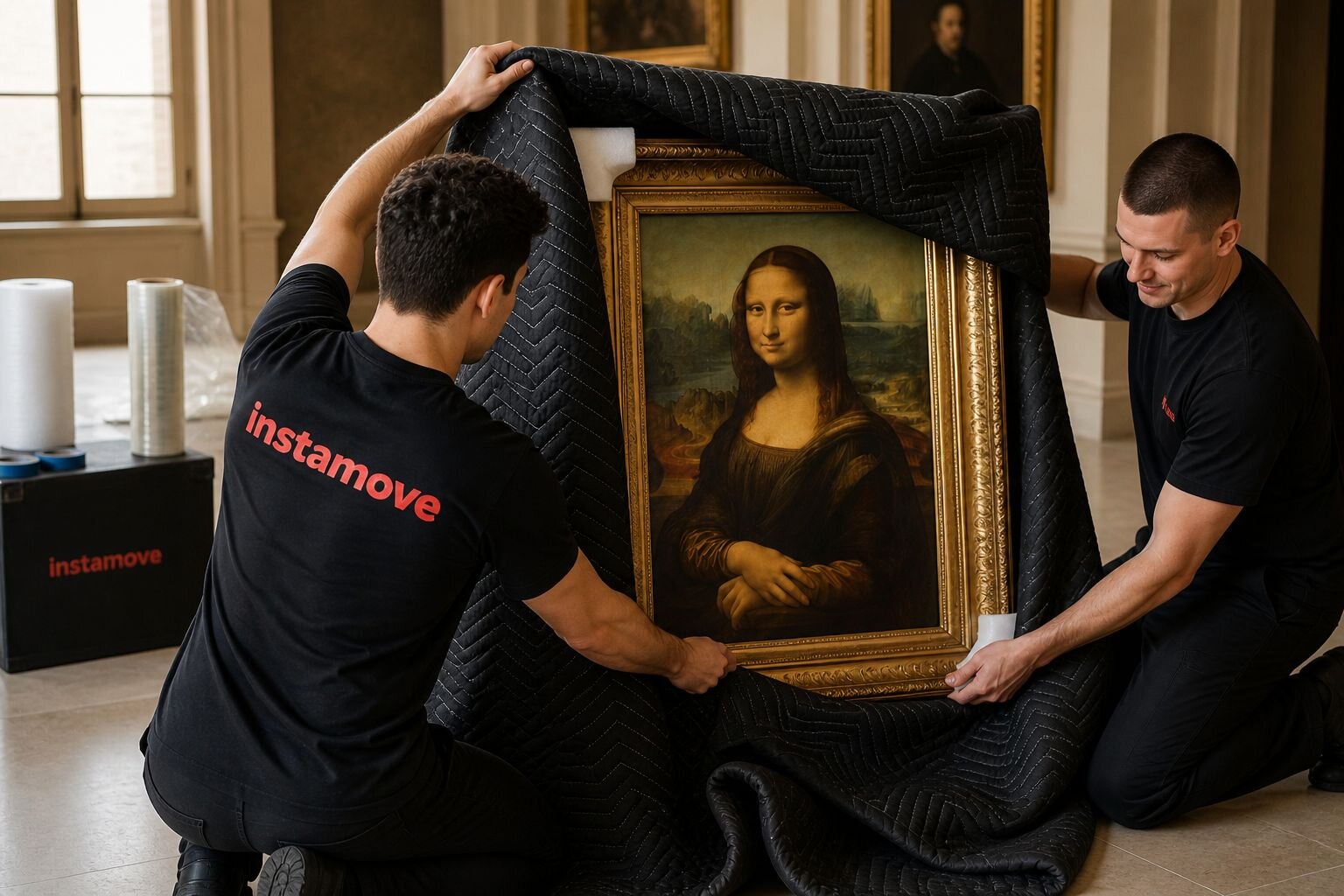
What actually damages a painting in a truck
The Australian Institute for the Conservation of Cultural Material is the professional body for conservators in this country. Its guidance on paintings names the agents of deterioration plainly, and three of the four have nothing to do with dropping anything.
| What does the damage | What AICCM says | What it means in a removal truck |
|---|---|---|
| Impact and pressure | Paintings are prone to damage by accidents and poor handling | The obvious one. Corners, glass, and anything stacked on top |
| Vibration | Stretched canvas is sensitive to vibration, which can cause paint flaking and loss | A truck is a vibration machine for days at a time |
| Heat | Temperature can increase the rate of deterioration, and cause increased sensitivity in synthetic polymer based paints | Acrylics soften. A blanket or bubble wrap pressed against a soft surface leaves its texture behind |
| Humidity | Painting supports are particularly vulnerable to humidity, since fluctuations cause the support to expand and contract and crack the overlying paint layers | Melbourne to Brisbane crosses several climates in one trip |
Two more from the same guidance that people forget: light causes fading, yellowing and embrittlement, so art should not sit in a sunny room waiting to be packed. And dust and dirt scratch the painted surface, which is why a clean wrapping layer matters more than a thick one.
AICCM's own advice on moving art is one line long: obtain specialist advice when transporting or storing paintings. The rest of this page is about the pieces where that is overkill, and being honest about where it is not.
Before you wrap anything, photograph it
This is the step people skip and later regret, and it costs five minutes.
Photograph every piece before it is wrapped: the whole work, then close-ups of the corners, the frame and any existing damage. Get the date in the file metadata by simply using your phone. If a painting arrives with a new scratch, this is the difference between a claim and an argument.
Conservators do exactly this. AICCM notes that paintings conservators provide condition reports and photography as part of their documentation. You are doing a domestic version of the same thing.
While you have each piece in your hands, note anything already loose, flaking or lifting. A painting with existing flaking should not go in a truck at all until a conservator has looked at it, because vibration will make it worse.
If you do not prepare your artwork yourself, you can generally expect the removalist to wrap it in bubble wrap or blankets on the day. That is reasonable protection for everyday pieces, but it is the standard treatment given to furniture. For anything of high value, do more than the default and prepare it properly yourself, using the method below.
The materials that matter
You need fewer things than most lists suggest, and two of the common recommendations actively cause damage.
| Use this | For what | Why |
|---|---|---|
| Acid-free tissue paper | The layer touching the artwork | Smooth and chemically stable, so it will not stick to varnish or paint. Art shops sell a version called glassine, which is the same idea. At a pinch, plain butcher's paper will do for a short move: never newspaper |
| Bubble wrap, bubbles facing out | Cushioning, over the paper layer | Never against the surface. Bubbles can emboss soft paint and trap moisture |
| Cardboard corner protectors | Frame corners | Where almost all frame damage happens |
| Rigid card or foam board | Front and back of the wrapped piece | Stops flex, which is what cracks panels and glass |
| Picture or mirror cartons | Framed works | Telescoping boxes sized for art rather than a generic carton |
| Low-tack artist's or painter's tape | Securing wrapping only | Never let tape touch the artwork or the frame finish |
| Clean cotton or nitrile gloves | Handling unglazed works | Skin oils stain, especially on paper and unvarnished surfaces |
Do not use newspaper against artwork. The ink transfers, particularly onto anything porous or slightly damp. If a guide tells you to wrap art in newspaper, stop reading it.
Do not use loose polystyrene beads. They generate static, cling to surfaces and migrate into frame gaps. Crumpled clean paper does the same job.
How to wrap a framed painting
Seven steps. Work on a clean, padded surface, not the floor.
- Photograph it first, front, back and corners, as above.
- Tape an X across the glass with low-tack tape. If the glass breaks the tape holds the pieces together instead of letting them slide down into the surface of the work.
- Lay acid-free tissue paper over the face of the artwork. This is the only layer that touches it. Art shops sell a smooth, non-stick version called glassine, which is what conservators use, but acid-free tissue does the job.
- Wrap the whole piece in bubble wrap, bubbles facing outwards, and tape the bubble wrap to itself, never to the frame.
- Fit cardboard corner protectors on all four corners.
- Sandwich the piece between two sheets of rigid card cut slightly larger than the frame, and tape those together.
- Slide it into a picture carton, fill the gaps with crumpled paper so nothing shifts, and label it with "artwork", "fragile", "this way up" and an arrow.
For anything genuinely valuable, replace step 2 with a conversation about acrylic glazing. Conservation framers routinely swap glass for acrylic before a long trip, because acrylic does not shatter into the artwork.
Unframed canvas and works on paper
Stretched canvas is the most vibration-sensitive thing in your house, and it has no glass protecting it.
Wrap the face in acid-free tissue, then build a simple frame of rigid card around the stretcher so nothing presses on the canvas itself. Never lay anything flat on a stretched canvas, and never stack them face to face without a rigid separator: pressure in the centre of an unsupported canvas is exactly how you get a permanent dent.
If you are rolling an unstretched canvas, roll it painted side outwards around a wide tube. Rolling paint-side-in compresses the paint layer and cracks it. Use a tube far wider than feels necessary, and do not put bubble wrap inside the tube, because it traps moisture against the surface.
Works on paper travel flat, between rigid boards, in a portfolio or a flat carton. Never roll a work on paper that has been framed flat for years.
The plastic wrap problem
Here is where a lot of otherwise sensible advice goes wrong, and it matters more in Australia than almost anywhere.
Several packing guides tell you to wrap artwork in layers of cling film or palette wrap. For an hour across town on a mild day, that is survivable. For a multi-day interstate trip it is a mould incubator, and the conditions are exactly the ones AICCM lists as sustaining mould growth: damp conditions, high humidity, warm temperatures, differential temperatures, poor air flow, and accumulation of dust and grease on surfaces.
AICCM's guidance is that relative humidity should be kept below 70% to prevent mould growth. Sealed plastic does the opposite of that. Any moisture already in the frame, the backing board or the air is now locked against the artwork, in the dark, warm, for days.
The rule: nothing airtight, ever, for a trip longer than a few hours. Breathable layers, then a rigid box. If the piece must be waterproofed for an outdoor leg, wrap the outside of the box, not the artwork.
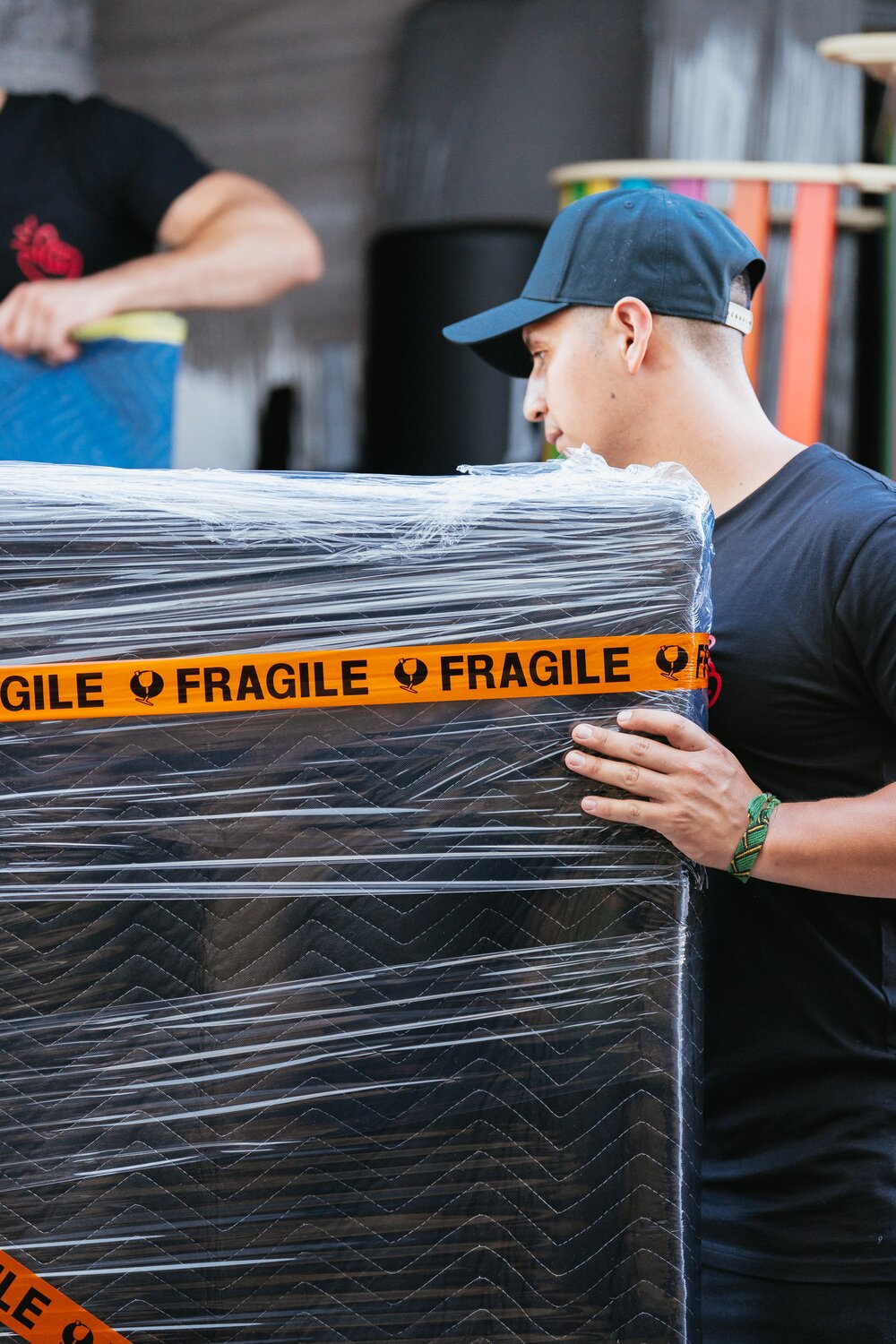
Loading: upright, never flat
Paintings travel on their edge, standing upright, like records in a crate. Never lay them flat, and never let anything rest on top of one, however light it looks.
Stand them face to face and back to back so that hanging hardware on one frame cannot press into the face of the next. Strap them against a wall of the truck rather than in the middle of the load, and put them in last so they come out first.
Keep them away from anything that will heat up, and away from the doors where the temperature swings hardest every time the truck is opened.
One thing to plan for if you own a lot of artwork: because paintings travel upright and nothing can be stacked on top of them, the removalist often cannot use the space above them. That clear headroom would normally be filled during the move, so a wall of framed works can take up more of the truck than its own size suggests, and that can affect the volume you are quoted for. If you have a large collection, mention it when you get your quote so the space is costed properly rather than discovered on the day.
What your removalist actually covers, and what it does not
This is the part almost no packing guide will tell you, and it changes what you should do with your best pieces.
Most removalists, Instamove included, exclude exactly this category from accidental damage cover. Our published Terms and Conditions exclude items that are inherently fragile, items inherently susceptible to damage however carefully they are handled, and the contents of any box not packed by an Instamove packer. In plain terms: a painting you wrapped yourself is generally not covered, with us or with most of our competitors.
That is not a reason to panic, it is a reason to make a deliberate choice about each piece rather than assuming the truck sorts it out.
On the insurance side, check your contents policy before you rely on it. Insurers commonly set an item limit above which they need documentation. Suncorp, for one, requires proof of purchase, a professional valuation and a photograph for items over $3,000. If you own a painting worth more than that and have never had it valued, the time to fix that is before the move, not during a claim.
If you are moving high-value pieces with a general furniture removalist, it is also worth considering specialist transit insurance for the load rather than relying on standard damage cover. We suggest Carts Removals insurance for this. It is designed for exactly this situation, where the value of what you are moving sits above what a standard removalist covers.
Whatever you do, raise any damage before the crew leaves. Our own terms make claims void once the job is signed off, which is standard across the industry and is why the end-of-job walkthrough matters more than it feels like it does at the end of a long day.
When to use an art courier instead
Every other page on this topic wants you to believe a removalist is always the answer. Here is the honest version.
Use a specialist art courier or a conservator-recommended transporter when:
- The piece is worth more than your removalist's damage cover, which is $1,000 on our backload service and $5,000 on an exclusive truck.
- It is an original by a collected artist, or has provenance or cultural significance.
- It is already fragile: flaking paint, an old repair, a brittle panel, a damaged frame.
- It is very large, oddly shaped, or needs a purpose-built crate.
- Your route is long and hot, and the piece is acrylic or unvarnished.
Carry it in your own car when:
- It fits, it is sentimental rather than valuable, and you would simply rather not risk it.
A removal truck is genuinely fine when:
- The piece is a print, a poster, a photograph or a decorative canvas, properly wrapped and boxed as above.
For most households that is nearly everything, and this whole page takes an afternoon. For the two pieces that matter, spend the money or put them on the back seat. If you want a professional opinion first, AICCM keeps a public directory of accredited conservators.
Moving interstate and working out what travels how? Get an instant quote and we will size the load with you, or read how interstate removals work for the process. Our packing materials range covers cartons and paper, and how to move a fridge, TV and fragile items handles the rest of the breakables.
Frequently asked questions
How do you pack a painting for moving?
Photograph it first, then lay acid-free tissue paper over the face, wrap the whole piece in bubble wrap with the bubbles facing outwards, fit cardboard corner protectors, sandwich it between two sheets of rigid card and slide it into a picture carton. Fill the gaps with crumpled paper and label the box with "artwork" and "this way up". Never let bubble wrap or tape touch the artwork itself.
Should you wrap paintings in bubble wrap?
Yes, but never directly against the surface. Bubble wrap is for cushioning and it goes over a layer of acid-free tissue paper. Pressed straight onto paint it can emboss the surface, especially with acrylics in warm weather, and it traps moisture. Face the bubbles outwards and tape the wrap to itself rather than to the frame.
Can paintings be transported flat?
No. Paintings travel upright on their edge, standing like records in a crate, and nothing should rest on top of them. Laid flat they take pressure across the centre, which dents unsupported canvas and flexes panels and glass. Stand multiple works face to face and back to back so hanging hardware cannot press into the next piece.
Do removalists cover damage to artwork?
Usually not. Most removalists exclude items that are inherently fragile and the contents of boxes packed by the customer, which covers most artwork. Instamove's published Terms and Conditions do exactly that. Ask any company for the specific exclusions in writing, and for anything valuable consider specialist transit insurance, an art courier, or your own car instead.
Is it safe to wrap art in cling film or plastic?
Not for a long trip. Sealed plastic traps moisture against the artwork, and AICCM lists damp conditions, warm temperatures and poor air flow among the things that sustain mould growth, recommending relative humidity be kept below 70%. Use breathable layers such as acid-free tissue and paper, then a rigid box. If you need waterproofing, wrap the outside of the box.
How should I pack an unframed canvas?
Cover the face with acid-free tissue, then build a rigid card frame around the stretcher so nothing presses on the canvas itself. Never stack stretched canvases face to face without a rigid separator. If the canvas is unstretched and must be rolled, roll it painted side outwards around a wide tube, because rolling paint-side-in compresses and cracks the paint layer.
Do I need to tape the glass on a framed picture?
It is worth doing. An X of low-tack painter's tape across the glass holds the pieces together if it breaks, instead of letting shards slide down into the surface of the artwork. For genuinely valuable pieces, ask a conservation framer about swapping the glass for acrylic before a long move, because acrylic does not shatter.
When should I use a specialist art courier?
When the piece is worth more than your removalist's damage cover, when it is an original with provenance or cultural significance, when it is already fragile or has flaking paint, or when it needs a purpose-built crate. AICCM's own advice is to obtain specialist advice when transporting or storing paintings, and it maintains a public directory of accredited conservators.


