
How to Pack Books for Moving
Pack books in a proper book box, about 52 litres, and stop filling before it gets heavy, not when it gets full. Lay books flat or stand them spine down, never spine up, fill the gaps with paper, and tape the base twice. Cull before you pack: books are the heaviest thing in the house per box. On an interstate move they are also the cheapest thing you own per cubic metre, so the cull is about your back, not your bill.
Here is the number that should change how you pack your bookshelf. A 500-sheet ream of ordinary A4 office paper weighs 2.5 kilograms. A book box holds the equivalent of a short stack of reams, which is why a box that looked harmless on the shelf turns into a two-person lift at the front door.
Most guides tell you to "use small boxes for books" and leave it there. This one explains why, what a full one weighs, what it costs to move, and when it is worth moving at all.
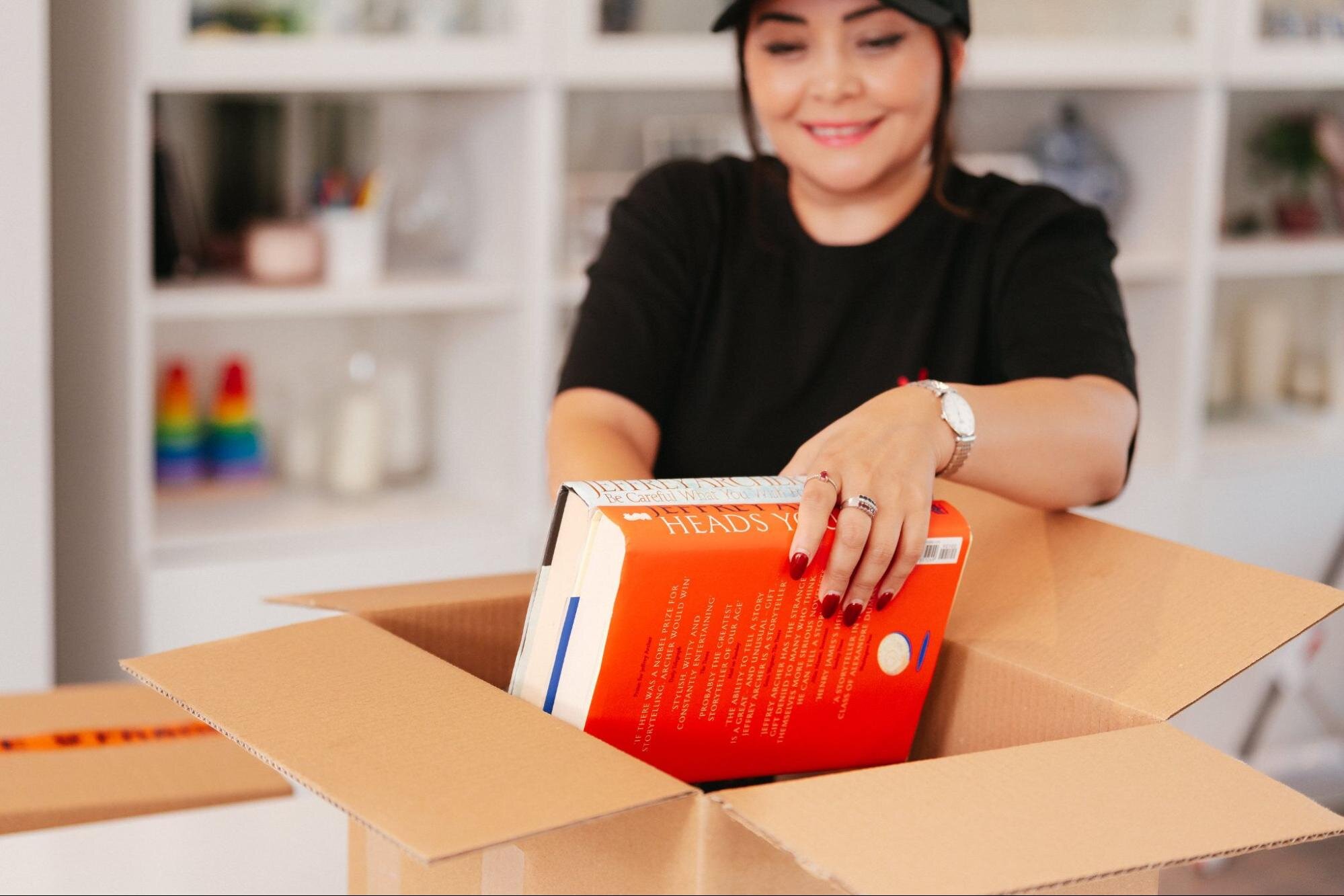
Why books are the heaviest box in the house
Books are dense. Paper packs tightly, covers add weight, and a box of them has almost no air in it, which is the opposite of a box of cushions.
Run the ream test yourself. The Instamove book box measures 406 by 298 by 431 millimetres, which is about 52 litres. Packed solid with paper it would weigh over 40 kilograms. Real books have covers, margins and gaps, so a book box filled to the brim with hardcovers still lands somewhere around 20 to 25 kilograms, which is why you stop before the brim.
That is why the box size matters more than anything else on this page:
- Book box, about 52 litres: the only box that should be mostly books. Hardcovers to about two-thirds, then linen or cushions on top; paperbacks can go higher.
- Any other general carton: books on the bottom third only, then lighter things on top.
- Large tea chest, 104 litres: never for books. Full of hardcovers it is a back injury waiting at the top of the stairs.
There is no legal maximum weight for lifting in Australia. Safe Work Australia's model code of practice on hazardous manual tasks asks you to manage the risk instead, which for a house move means smaller boxes, closer to the body, and two people on anything heavy. Your removalists lift for a living, but they still have to get that box down your hallway.
First, work out how you are being charged
Books are unusual: they are the heaviest thing you own per box and the cheapest thing you own per cubic metre. Which one matters depends on how your move is priced.
| Local move | Interstate move | |
|---|---|---|
| How it is priced | By the hour, plus crew size | By the cubic metre, plus distance |
| What books cost you | Time. Thirty heavy boxes is thirty slow trips to the truck | Almost nothing. A full book box is only 0.052 cubic metres |
| So the cull is about | Money and your back | Your back only |
| Best strategy | Fewer, smaller boxes, staged near the door | Pack them all, pack them tight, put them low on the load |
Most readers are on the hourly side of that table. Across 741 confirmed Instamove bookings in August 2026, 88% of moves stayed within the same state, and the typical move covered under 10 kilometres. On a local move, every box of books you do not take is a few minutes you do not pay for.
If you are crossing a border, the arithmetic flips. A backload starts at a reserved volume of 10 cubic metres, and you can fit roughly 19 full book boxes in a single cubic metre. Your entire library is a rounding error on the truck. Interstate, keep the books and cull the bulky things instead. If you can flex your dates for a consolidated load or backload, the whole move gets cheaper, books included.
Cull before you pack, not after
The cheapest book to move is the one you leave behind. Start the sort three to four weeks out, one shelf per evening, so it never becomes a Sunday-night ordeal.
Four piles work better than two:
- Keep. You will read it again, you lend it, or it belongs to someone you love. No justification needed.
- Donate. Op shops, street libraries, school and community fairs, and hospital auxiliaries all take clean, current books. Ring first: many op shops are full of encyclopaedias and cannot take more.
- Sell. Recent fiction, cookbooks, textbooks and children's picture books move quickly on Marketplace or through secondhand bookshops. Be realistic: most books are worth more as a donation receipt than a listing.
- Recycle. Water-damaged, mouldy or mildewed books go in the recycling, not in a box next to the good ones. Mould spreads.
Two honest questions for the fence-sitters: have you opened it in five years, and would you buy it again today? If the answer to both is no, it can go.
Where possible, finish the cull before the boxes arrive. If you are closer to moving day than that, don't panic. Pack the definite keeps, box the maybes separately and labelled, and make the call when you unpack.
The right box for books
Use a book box. It is the sturdy, double-walled carton in every removalist's range, and it exists for exactly this reason. Instamove supplies book boxes as part of the packing materials range, delivered to your door or included with a packing service.
| Box | Capacity | Use for books? | Why |
|---|---|---|---|
| Book box (406 x 298 x 431 mm) | about 52 litres | Yes, to a comfortable lift | Double-walled base built for the weight. Hardcovers to two-thirds, paperbacks higher |
| General household carton | varies | Bottom third only | Usually single-walled; full of books it splits or strains a back |
| Large tea chest | 104 litres | No | Twice a book box of weight in one grip |
| Wine or supermarket carton | varies | Only if double-walled and dry | Free boxes are often single-wall and already softened |
| Plastic tub | varies | Yes for storage, with a lid that seals | Rigid, stackable, but traps moisture if books go in damp |
For current box prices across Bunnings, Officeworks, Kennards and the Instamove range, see the cost of moving boxes in Australia. Book boxes are among the cheapest cartons sold, so there is no saving in squeezing books into something bigger.
Skip the "book boxes must be new" advice. A secondhand double-walled book box from a bookshop or office is excellent. What matters is that it is dry, square and has never been soaked.
How to pack a book box: the method
A book box is packed in layers, heaviest at the bottom, with no room for anything to slide. Here is the order.
- Tape the base twice. One strip along the seam, one across it, then a third across the middle if the box has done a move before. The base carries the weight; the lid only keeps the dust out.
- Line the bottom. A sheet of packing paper or a flattened cereal box keeps the first layer off any damp the box picks up on a driveway.
- Lay the biggest books flat first. Coffee-table books, atlases and thick hardcovers go on the bottom, flat, largest at the base. Flat is the safest orientation there is for a heavy book.
- Stand the rest spine down or pack them flat. Spine down means the pages sit on the spine, which is built to hold them. Spine up lets the page block hang off the binding and pull it apart over a long drive. The Library of Congress preservation guide is blunt on this: books should never be stored spine up.
- Alternate spines. In each upright row, face the spines left, right, left, right. It keeps the row level and stops one end sitting taller than the other.
- Fill every gap. Crumpled packing paper, socks, tea towels. A book that can move is a book that will bump.
- Stop at a comfortable lift. Close the flaps, lift the box a few centimetres. If you hesitate, take four books out. The box should never be the heaviest thing you carry.
- Tape, label, arrow. Tape the lid, write "BOOKS" and the room on two sides, add a "this way up" arrow, and mark "FRAGILE" only if it genuinely is. Crying wolf on every box means nobody reads it.
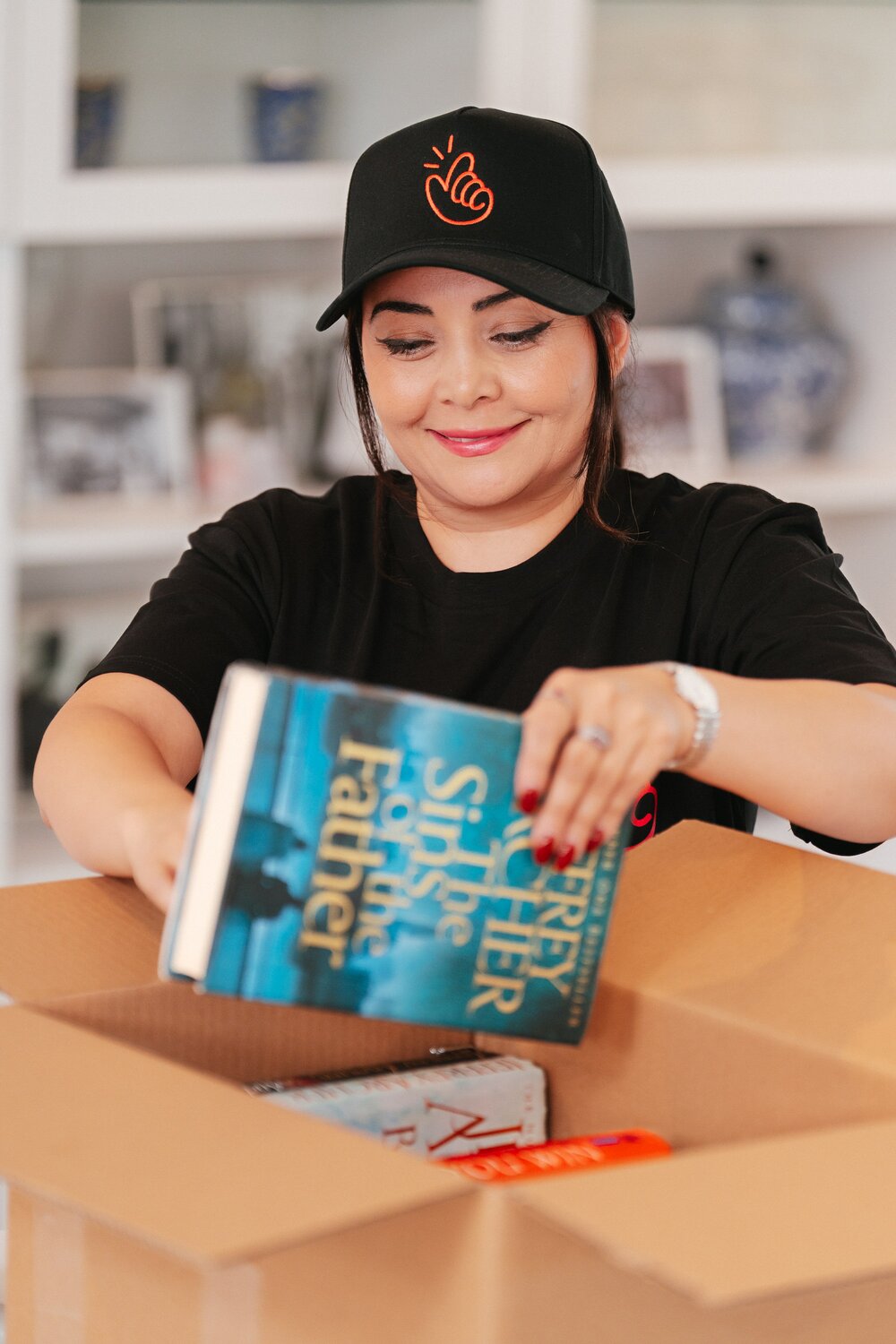
Paperbacks, hardcovers and the ones that matter
Not every book needs the same treatment. Most need almost none.
| Book type | How to pack | Extra protection |
|---|---|---|
| Paperbacks | Spine down in rows, or flat in stacks. Pack snugly, they flex | None needed |
| Hardcovers with dust jackets | Flat, jackets on, largest at the bottom | A sheet of paper between jackets stops them scuffing |
| Oversize and coffee-table | Flat only, bottom of the box, never more than a few per box | Corners are the weak point: pad them |
| Children's board books | Anywhere, they are indestructible | None |
| Signed, first editions, family bibles | Wrap individually in acid-free tissue, then a snug box of their own | Travel in your car, not the truck |
| Damp or mouldy books | Do not pack with the others | Dry fully first or recycle |
The last row matters more than it looks. One musty book in a sealed box for a three-day interstate run can hand its problem to every neighbour. If a book smells like a beach house, deal with it before it goes in.
For the genuinely valuable ones, the rule is the same as for jewellery and documents: they travel with you.
Books going into storage
Storage is where books get hurt, not in the truck. In the year to 27 September 2026, 15% of long-haul moves included a storage stop, and the timing is often longer than planned.
Books want a cool, dry, dark room. The Library of Congress guide to preserving books puts the safe range at 21 degrees or below and 30% to 55% relative humidity, and specifically warns against garages, attics and basements, where temperature swings, damp and the risk of leaks are all highest.
For an Australian storage stop, that translates to:
- Choose a climate-controlled unit, or at least an indoor one. A shipping container in a paddock in February is neither.
- Keep boxes off the floor on a pallet or a couple of planks. Water finds the bottom box first.
- Do not overpack for storage. Books need a little air. A box packed as tight as a transit box will slump the spines over six months.
- Add a silica gel sachet per box if the unit is not climate-controlled, and check the boxes once a season.
- Use plastic tubs only if the books go in bone dry. A sealed tub with a damp book inside is a mould incubator.
Who carries the heavy boxes, and who covers them
Your removalists carry them, and they will be glad you used book boxes. A few small things make the day faster for everyone:
- Stage book boxes together near the door, so the crew can run them in one stretch rather than hunting.
- Never stack a book box on top of a light one. Book boxes go on the floor of the truck and the bottom of any stack.
- Tell your removalist roughly how many. "About 25 book boxes" on the booking helps size the crew and the truck.
On cover: boxes you pack yourself are not covered for accidental damage to their contents under Instamove's standard terms, and that is true of most Australian removalists. For books this barely matters. A paperback packed with the method above survives almost anything. It is the reason valuable editions travel with you, and the reason the kitchen is where a packing service earns its money.
Unpacking: the ten-minute shelf
Unpack books early. A full bookshelf is the fastest way to make a strange house feel like yours, and boxes of books left in a corner for a month are the ones that end up in the garage.
Shelve books upright, similar sizes together so covers support each other, spines down for anything too tall to stand. Keep the shelf out of direct sun. The Library of Congress guide notes that light fades covers and weakens paper, and a north-facing window in an Australian summer is a serious light source.
Heaviest books on the lowest shelves, both for the bookcase and for the next time you move.
FAQ
What is the best way to pack books for moving?
Use a proper book box of about 52 litres, tape the base twice, lay the biggest books flat on the bottom and stand the rest spine down. Fill gaps with crumpled paper so nothing slides, stop when the box is a comfortable lift for one person rather than when it is full, and label two sides. Never pack books in a tea chest.
What size box should I use for books?
A book box, which in the Instamove range is a double-walled carton of 406 by 298 by 431 millimetres, about 52 litres. It is the only box that should be mostly books, and even then stop at a comfortable lift. Other cartons can take books on the bottom third with lighter items above. Tea chests full of books are unsafe to lift and often split at the base.
How heavy should a box of books be?
Light enough to lift without hesitating, which for most people means under about 20 kilograms, so a 52 litre book box should not be filled to the brim with hardcovers. There is no legal maximum lifting weight in Australia; Safe Work Australia's hazardous manual tasks code asks you to reduce the risk instead. Smaller boxes, held close to the body, with two people on anything awkward, does that.
Should books be packed flat or standing up?
Both are safe. Flat suits big, heavy hardcovers and goes on the bottom. Standing spine down suits paperbacks and fills a box neatly. The one orientation to avoid is spine up, because the weight of the pages hangs off the binding and loosens it over a long drive. Alternate spines left and right so rows stay level.
Do I need to wrap books individually?
No, not for everyday paperbacks and hardcovers. Snug packing and gap-filling protect them. Wrap only signed copies, first editions, antique bindings and anything with sentimental value, using acid-free tissue, in a box of their own. Those should travel in your car rather than on the truck.
How should I store books long term after a move?
Cool, dry and dark. The Library of Congress recommends 21 degrees or below and 30% to 55% relative humidity, and warns against garages, attics and basements. In practice choose an indoor or climate-controlled unit, keep boxes off the floor, add a silica gel sachet per box, and check on them once a season.
Do removalists charge more for heavy boxes of books?
Not per box, but books cost you in different ways depending on the move. Local moves are priced by the hour, so many heavy boxes slow the load and add time. Interstate moves are priced by the cubic metre, and books are dense, so a whole library takes very little space on the truck.
Is it worth paying a packing service for books?
Usually not for books alone. Books are the easiest category to pack well yourself, and most people do. A packing service earns its money in the kitchen and with fragile items, and it also brings your packed boxes inside the removalist's accidental damage cover, which self-packed boxes are not.


